
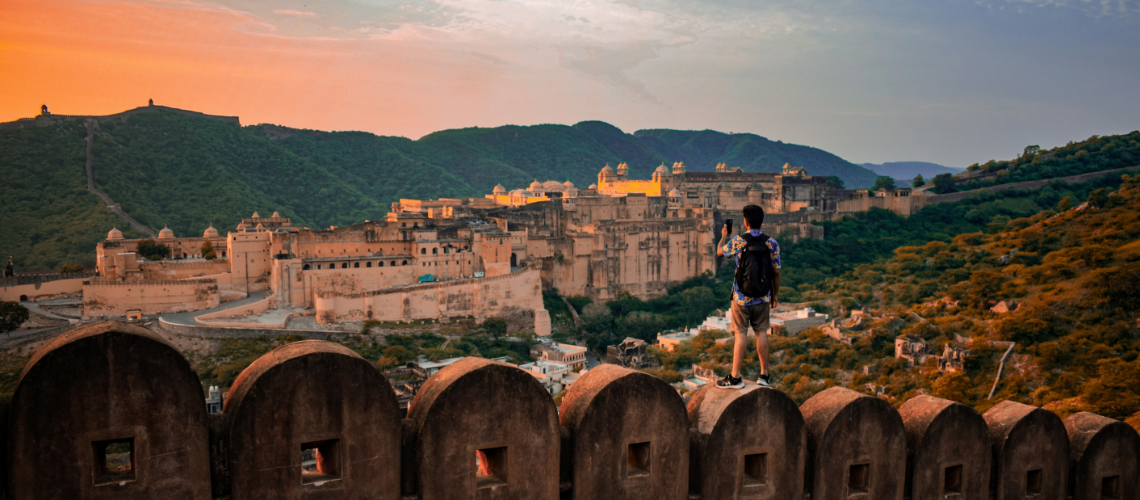
The places to visit in Jaipur range from one of India’s finest hilltop forts to a UNESCO-listed astronomical observatory, from a palace still inhabited by royalty to a honeycomb facade that has become the symbol of the entire city. As the first planned city in India and one corner of the Golden Triangle, Jaipur packs an extraordinary concentration of world-class sights into a compact and walkable old city, surrounded by hilltop fortresses. This guide covers every significant place worth visiting, with the historical context, practical details, and honest guidance you need to plan your time in the Pink City.
For activity ideas and trip planning, see our things to do in Jaipur and Jaipur travel guide.
Amber Fort (Amer Fort)
The Amber Fort, about 11 kilometres from the city centre, is the crowning glory of Jaipur and one of the finest forts in India. Built from 1592 by Raja Man Singh I, it served as the Kachhwaha Rajput capital before Jaipur was founded in 1727. Set on a hill overlooking Maota Lake, this UNESCO World Heritage Site combines Rajput and Mughal architecture across a series of grand courtyards and palaces.
The highlight is the Sheesh Mahal (Mirror Palace), where thousands of tiny mirror pieces cover the walls and ceiling, designed so that a single candle flame would be reflected across the entire chamber. Other highlights include the ornate Ganesh Pol gate (the most photographed entrance in the palace), the Diwan-i-Aam (Hall of Public Audience), the Diwan-i-Khas (Hall of Private Audience), and the Shila Devi temple. Arrive early (by 8 to 8:30 am) to enjoy the fort before the crowds, and allow two to three hours. Walk up the paved ramp rather than taking an elephant ride.
City Palace
The City Palace, in the heart of the old city, was conceived by Jai Singh II, the founder of Jaipur, and expanded by later rulers. A beautiful fusion of Mughal and Rajput architecture, it remains the home of Jaipur’s royal family, who reside in the Chandra Mahal. The complex includes the Mubarak Mahal (the reception palace, now housing a textile and costume museum), the Maharani’s Palace (displaying royal weaponry), ornate courtyards, and the famous painted Peacock Gate. The armoury and textile galleries are particularly good. Allow one and a half to two hours.
Hawa Mahal
The Hawa Mahal (Palace of Winds), built in 1799 by Maharaja Sawai Pratap Singh, is Jaipur’s most iconic landmark. Its five-storey pink sandstone facade of 953 small latticed windows (jharokhas) was designed so that royal women could observe street life and processions without being seen, and its shape resembles the crown of Lord Krishna. The latticework also channels cool air through the building. The best view and photograph are from across the street, ideally from a rooftop cafe opposite in the morning light, though you can also climb up inside for window-framed views of the city.
Jantar Mantar
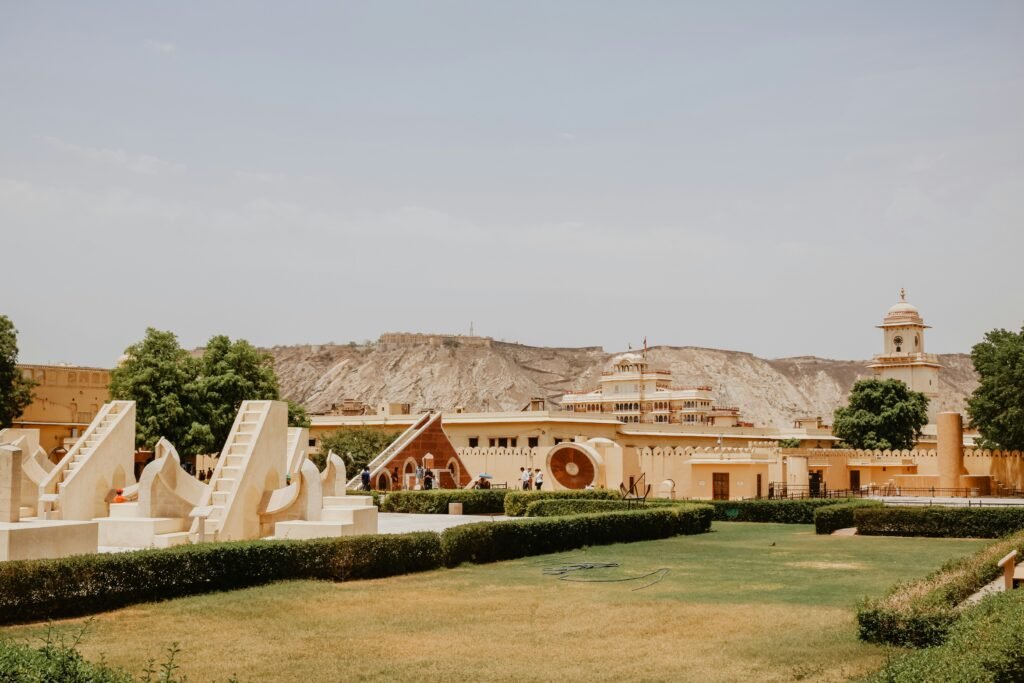
Jantar Mantar, next to the City Palace, is a UNESCO World Heritage Site and the largest of the five astronomical observatories built by Jai Singh II (the others are in Delhi, Ujjain, Mathura, and Varanasi). It contains a collection of monumental stone instruments designed to measure time, track celestial bodies, and observe the orbits of the planets, including the Samrat Yantra, the world’s largest stone sundial, accurate to within seconds. A guide or audio guide greatly enhances a visit by explaining how each instrument works.
Nahargarh Fort
Nahargarh Fort, built in 1734 on the Aravalli ridge above the city, offers spectacular panoramic views over Jaipur, particularly at sunset. The fort’s Madhavendra Bhawan, a suite of interconnected royal apartments, is worth exploring, and the hilltop cafe makes it a perfect spot to end a day. Nahargarh, Jaigarh, and the Garh Ganesh temple form an impressive backdrop to the city.
Jaigarh Fort
Jaigarh Fort, above Amber, was built to protect the Amber Fort and houses the Jaivana, once the largest cannon on wheels in the world. The fort’s massive ramparts, water harvesting systems, and views over the Amber complex make it a rewarding visit, often combined with Amber Fort.
Jal Mahal
The Jal Mahal (Water Palace) appears to float in the middle of Man Sagar Lake, its sandstone walls contrasting beautifully with the blue water. You cannot go inside, but the view from the promenade, particularly at dusk, is one of the most photographed sights in Jaipur, and it makes a lovely (free) stop on the road to or from Amber Fort.
Albert Hall Museum
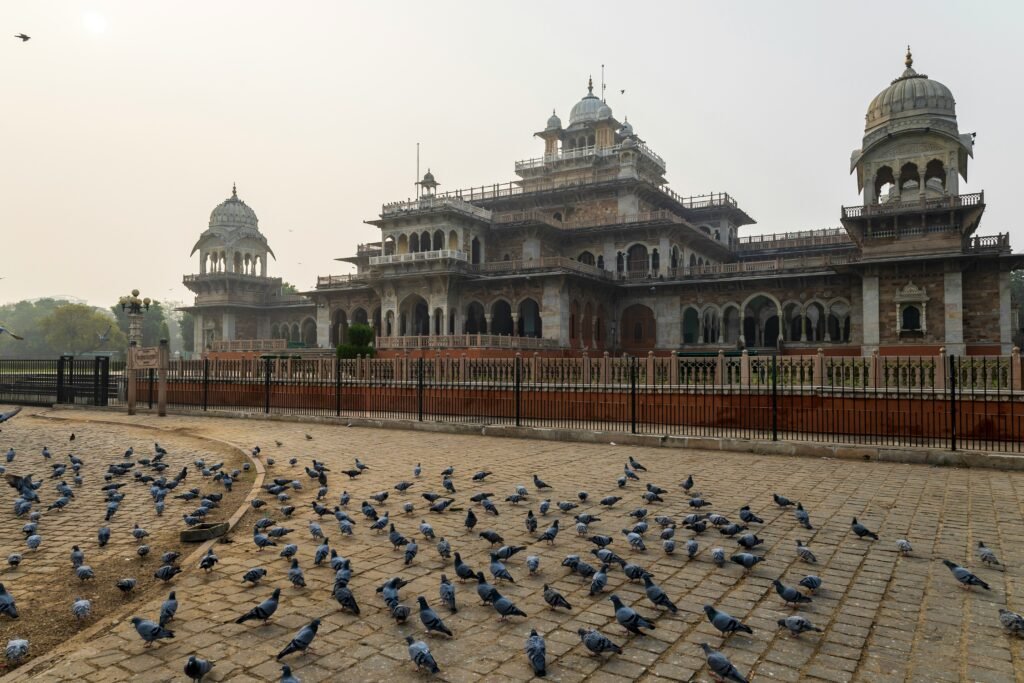
The Albert Hall Museum, in Ram Niwas Garden outside the old city walls, is the oldest museum in Rajasthan and a striking example of Indo-Saracenic architecture, designed by Sir Samuel Swinton Jacob and named after King Edward VII (Albert Edward), who laid its foundation stone in 1876. Its collection includes metalwork, woodcraft, carpets, sculptures, arms, and a notable collection of miniature paintings. The building is beautifully illuminated at night.
Panna Meena Ka Kund
The Panna Meena Ka Kund, near Amber Fort, is a beautifully symmetrical ancient stepwell, with its criss-crossing staircases creating a mesmerising geometric pattern. Less visited than the main sights, it is a rewarding and photogenic stop for those exploring the Amber area.
Gaitore and Galtaji
The Gaitore Ki Chhatriyan are the royal cenotaphs of Jaipur’s former rulers, a peaceful and often overlooked site of beautifully carved white marble memorials. Galtaji, the Monkey Temple, is a complex of temples built into a mountain pass, famous for its resident macaques and sacred water tanks, offering a unique and atmospheric experience away from the main circuit.
Plan your Jaipur visit with Immersive Trips
At Immersive Trips, we help travellers experience the best of Jaipur’s extraordinary sights, with the local knowledge to get the timing, guides, and logistics right. Get in touch with our team to plan your Pink City visit.
Frequently Asked Questions About Places to Visit in Jaipur
What is the most important place to visit in Jaipur?
The Amber Fort is the most important and impressive place to visit in Jaipur, a magnificent UNESCO-listed hilltop fort-palace with the dazzling Sheesh Mahal (Mirror Palace) at its heart. It is the highlight of any Jaipur itinerary and should be visited early in the morning to avoid crowds.
How many places can I visit in Jaipur in one day?
In one day, you can comfortably visit Amber Fort (early morning), Jal Mahal (a photo stop), the City Palace and Jantar Mantar (combined), the Hawa Mahal (from the street), and Nahargarh Fort for sunset. This covers the essentials, though two to three days allow for a fuller experience.
What is special about the Sheesh Mahal at Amber Fort?
The Sheesh Mahal (Mirror Palace) at Amber Fort is covered in thousands of tiny mirror pieces on its walls and ceiling, designed so that the light of a single candle flame would be reflected across the entire chamber, creating a dazzling starlit effect. It is one of the most beautiful interiors in any Indian fort.
Why is the Hawa Mahal famous?
The Hawa Mahal (Palace of Winds) is famous for its distinctive five-storey facade of 953 small latticed windows, designed so royal women could observe street life unseen, and shaped to resemble the crown of Lord Krishna. It is the most photographed and iconic landmark in Jaipur.
What is Jantar Mantar, and is it worth visiting?
Jantar Mantar is a UNESCO-listed astronomical observatory built by Jai Singh II, containing monumental stone instruments including the world’s largest stone sundial, accurate to within seconds. It is well worth visiting, particularly with a guide who can explain how the remarkable instruments track time and celestial movements.
Is the City Palace still lived in?
Yes. The City Palace remains the home of Jaipur’s royal family, who reside in the Chandra Mahal section. Much of the complex, including the museums, courtyards, and the famous Peacock Gate, is open to visitors, while the royal residence remains private.
Which places in Jaipur are free to visit?
Viewing the Hawa Mahal from the street, seeing the Jal Mahal (Water Palace) from the promenade, exploring the old city bazaars, and visiting the Panna Meena Ka Kund stepwell are all free or very low cost. These offer a rich experience of the city without entry fees.
What is the best time to visit Jaipur’s forts?
Early morning (by 8 to 8:30 am) is the best time to visit the forts, particularly Amber Fort, to enjoy the beautiful light and avoid the tour-bus crowds and midday heat. Nahargarh Fort is best visited in the late afternoon for its sunset views. Weekdays are quieter than weekends.
Should I buy the Jaipur composite ticket?
Yes, if you plan to visit three or more of the covered sites (Amber Fort, Hawa Mahal, Jantar Mantar, Nahargarh Fort, and the Albert Hall Museum). It saves money over individual tickets and is valid for two consecutive days. It is available at any of the covered sites.
Are there any lesser-known places worth visiting in Jaipur?
Yes. The Panna Meena Ka Kund stepwell near Amber, the peaceful Gaitore royal cenotaphs, the Galtaji Monkey Temple, and the beautifully illuminated Albert Hall Museum at night are all rewarding and less crowded than the main sights, offering a deeper and more relaxed experience of the city.