
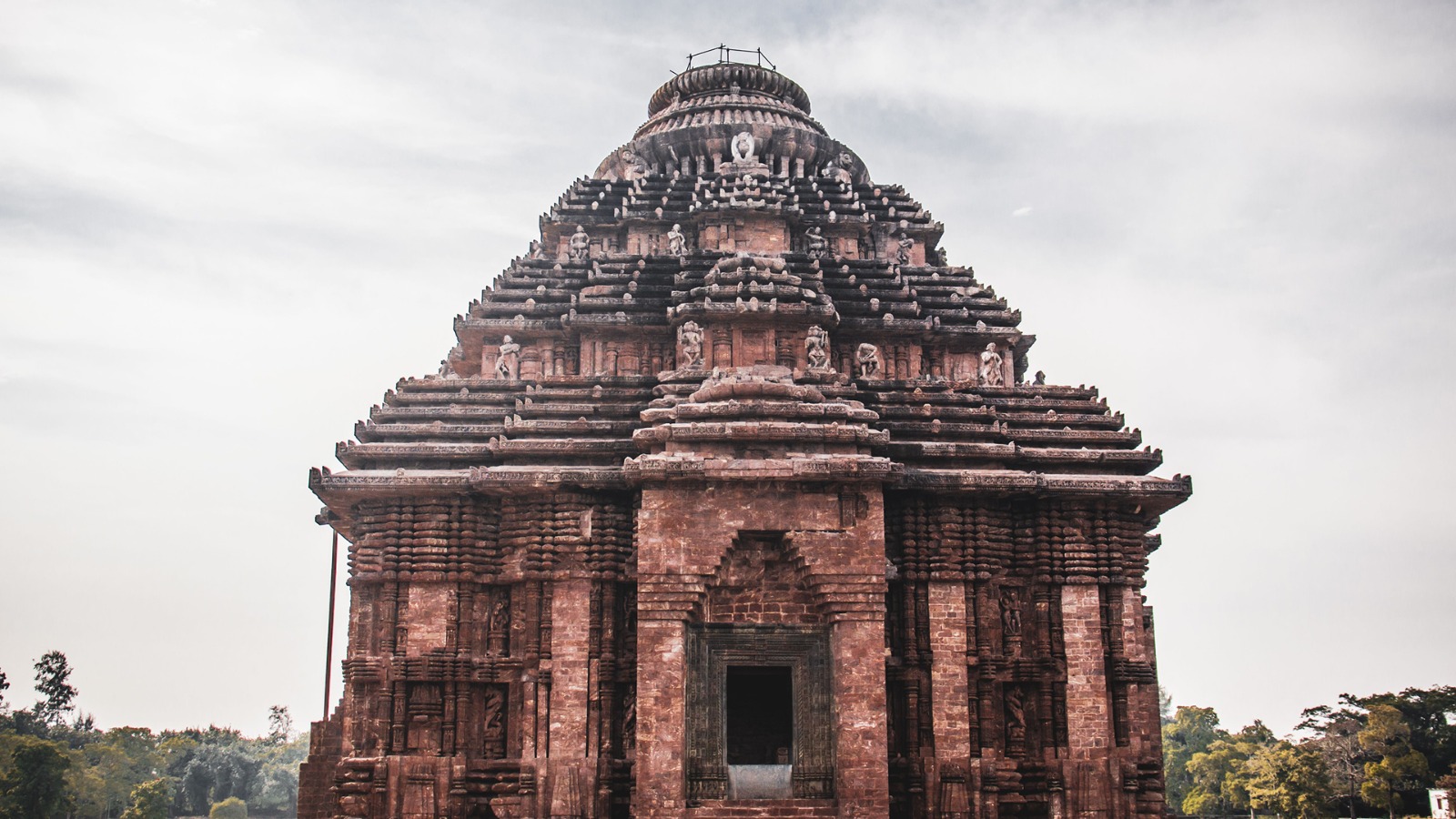
The east coast of India strings together several of the country’s most significant pilgrimage and heritage stops inside a single manageable route, and this seven-day Kolkata Puri tour package from Immersive Trips covers the ground without doubling back on itself. The route opens in Kolkata for a day of colonial-era sightseeing, crosses south to Sagar Island for the Gangasagar pilgrimage (with notes on timing it around the Gangasagar Mela), boards the overnight Howrah to Puri train and lands in Odisha for Jagannath temple darshan, the Konark Sun Temple and two nights of coastal excursions before finishing in Bhubaneswar. This piece walks through the Kolkata Puri tour package stop by stop.
What This Kolkata Puri Tour Package Covers
Six nights and seven days, weighted deliberately toward the Odisha side. Day 1 is Kolkata sightseeing. Day 2 crosses to Sagar Island. Day 3 returns to Kolkata and boards the overnight train south. Day 4 begins with Jagannath temple darshan at Puri and continues to Konark. Day 5 is the Chilika Lake excursion. Day 6 drives north to Bhubaneswar via Pipli and Dhauli. Day 7 is a straightforward departure day from Bhubaneswar airport.
Accommodation is arranged in advance at 3-star properties across Kolkata, Gangasagar, Puri (two nights) and Bhubaneswar, with the overnight train covered as an A/C 3-tier sleeper on the Howrah-Puri route. Ground transport is in an air-conditioned car or coach across the whole itinerary, with one specific exception for the Kachuberia to Ganga Sagar to Kachuberia stretch on Sagar Island itself, where the local shuttle vehicles run without air conditioning.
Kolkata on Day 1
Day 1 covers the colonial spine of central Kolkata in a single loop. Dalhousie Square, still officially BBD Bagh, holds the densest cluster of British-era administrative buildings in the country, including Raj Bhavan (the former Government House), the Writer’s Building (the East India Company’s original secretariat), St. John’s Church, the Calcutta High Court, the GPO and Town Hall. From there the route moves through the flower market beneath Howrah Bridge, one of the largest wholesale flower markets in Asia, before crossing the bridge itself, a cantilever spanning the Hooghly that carries an estimated 100,000 vehicles daily.
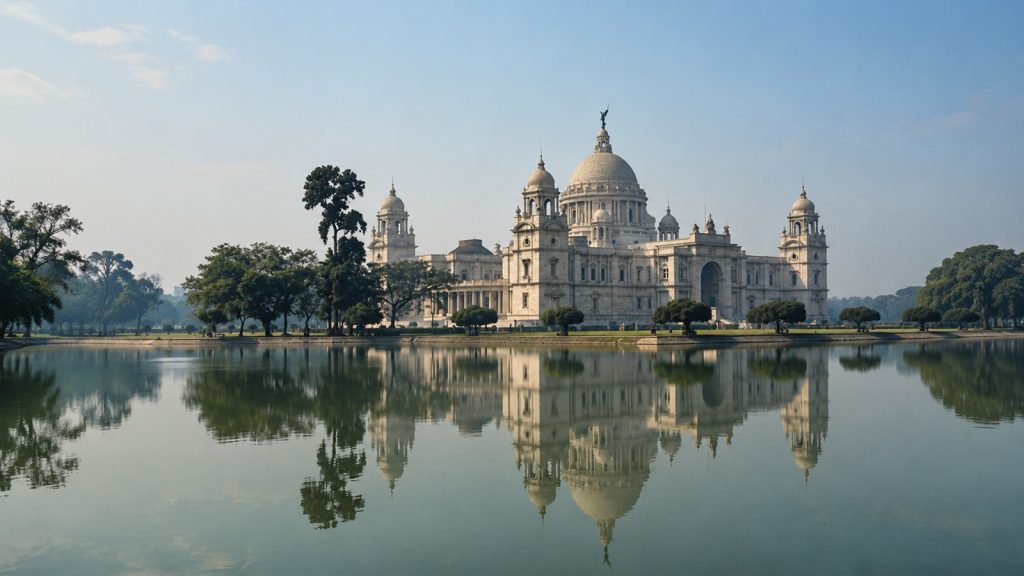
St. Paul’s Cathedral, consecrated in 1847 as one of the earliest Anglican cathedrals in Asia, and the Indian Museum, founded in 1814 and the oldest museum on the subcontinent, sit within a short drive of each other in Chowringhee. The Indian Museum closes on Mondays and national holidays, and Victoria Memorial (the white marble monument to Queen Victoria completed in 1921) follows the same closed-Monday schedule. The day closes with Kalighat Kali Temple, one of the 51 Shakti Peethas of Hindu tradition and the site from which the city takes its name.
Gangasagar and the Sagar Island Ferry
Day 2 covers the drive south from Kolkata to Kachuberia, the mainland jetty for the government ferry across to Sagar Island. Sagar Island sits at the point where the Ganga empties into the Bay of Bengal, and the Kapil Muni Temple at its southern tip is the anchor shrine of the Gangasagar pilgrimage. A bath at the confluence here is traditionally believed to carry equivalent spiritual merit to bathing at any of the northern Ganga sites over a much longer period.
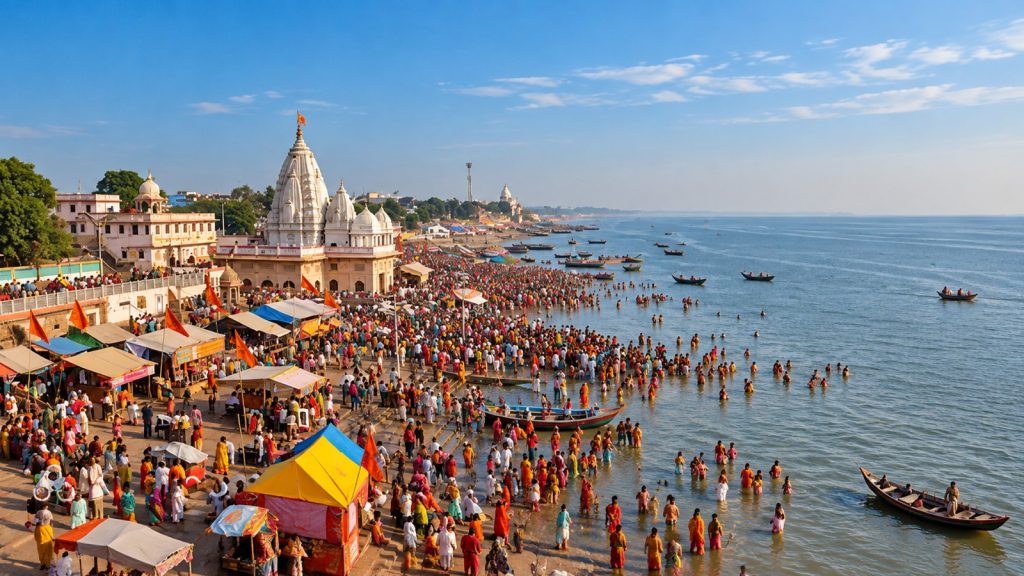
The Gangasagar Mela, held annually around Makar Sankranti (14 to 15 January), draws several million pilgrims across a few days and ranks as India’s second-largest religious congregation after the Kumbh Mela at Prayagraj. Outside the Mela window, the crossing is calm and the temple grounds workable at a slower pace, which is what most departures on this route target.
The Overnight Train to Puri
Day 3 returns to Kolkata by the reverse ferry route and boards the overnight Howrah to Puri train, an A/C 3-tier sleeper on one of the standard evening services. The journey runs roughly 10 to 11 hours depending on the train and arrives in Puri in the morning, which sets up Day 4 for the temple and Konark excursion without requiring a rest day on arrival.
Overnight rail on this stretch has been the default option for decades. It skips a full driving day on the NH16 corridor between Kolkata and Puri and lands travellers into Odisha rested enough for a temple visit by mid-morning.
Jagannath Temple Darshan at Puri
Day 4 begins with Jagannath temple darshan at Puri, one of the four Char Dham pilgrimage sites of Hindu tradition (alongside Badrinath, Dwarka and Rameswaram) and one of the most visited temples in eastern India. The presiding deities, Jagannath (a form of Vishnu), his elder brother Balabhadra and their sister Subhadra, sit inside a sanctum that non-Hindu visitors are not permitted to enter, though the temple’s 65-metre spire and the outer courtyards are visible from the surrounding streets and from the raised platform at Raghunandan Library across the road.

The temple opens for its earliest darshan around 5 a.m., with the main ritual sequence building through the day around the Mangala Aarti in the morning and the Sandhya Aarti in the evening. Jagannath temple darshan on this itinerary is scheduled for the morning slot to leave the afternoon clear for Konark.
The Konark Sun Temple Excursion
The rest of Day 4 covers the Konark Sun Temple, roughly 35 kilometres east of Puri along the coastal road. Built in the 13th century under the Eastern Ganga king Narasimhadeva I, the Konark Sun Temple was conceived as a monumental stone representation of the sun god Surya’s chariot, complete with 24 carved wheels and seven horses hauling it eastward toward the sunrise. UNESCO added the temple to its World Heritage List in 1984, and even in its partially collapsed state (the main tower fell centuries ago and only the jagamohan and the base survive intact), the surviving carving ranks among the finest stonework in India.
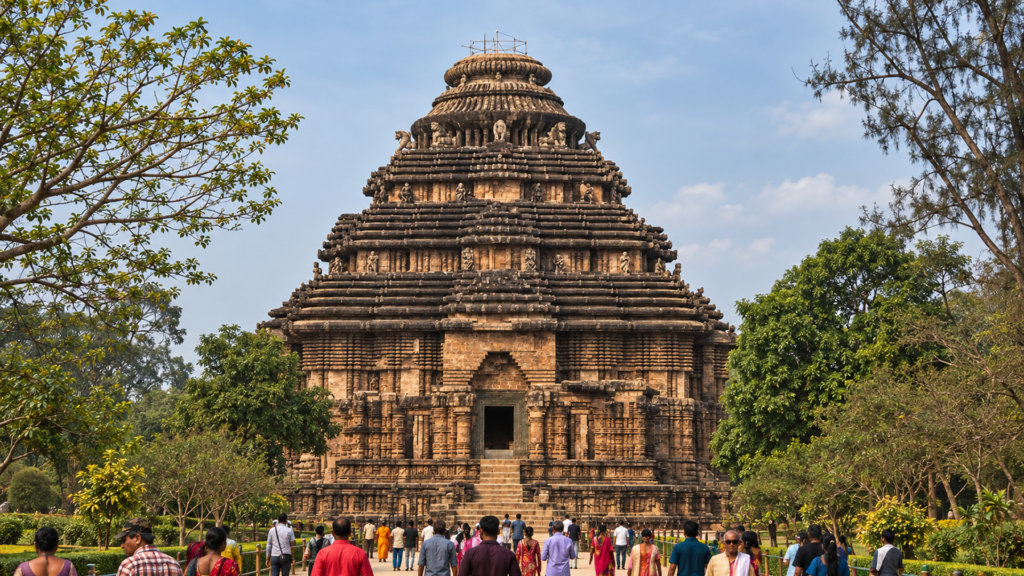
The Konark Sun Temple site also holds the smaller Mayadevi Temple and an Archaeological Survey of India museum, both worth walking through if the schedule allows before the return drive to Puri.
Chilika Lake on Day 5
Day 5 is given over to the Chilika Lake excursion, roughly 50 kilometres south of Puri. Chilika is Asia’s largest brackish water lagoon, covering around 1,100 square kilometres between the Eastern Ghats and the Bay of Bengal, and the boat trip from Satpada targets the lagoon’s resident Irrawaddy dolphin population, one of only two known lagoon-dwelling populations of the species in the world. Sightings are reasonably reliable between October and March. Chilika also holds a scatter of small islands, including Kalijai Temple set on one of them, and supports more than 200 bird species during the winter migration.
Pipli, Dhauli and the Arrival at Bhubaneswar
Day 6 drives north from Puri to Bhubaneswar with two heritage stops built in. Pipli, a small village about 20 kilometres from Bhubaneswar, is known for its appliqué craft, particularly the brightly stitched umbrellas, canopies, wall hangings and lampshades that traditionally covered the Rath Yatra chariots at Puri and now sell across markets in both cities.
Dhauli, closer to Bhubaneswar, marks the site of the Kalinga War in 261 BCE, where Emperor Ashoka’s victory over the Kalinga kingdom triggered his conversion to Buddhism and the subsequent spread of the religion across South and Southeast Asia. The Shanti Stupa on Dhauli Hill, built in 1972 by the Japan Buddha Sangha and the Kalinga Nippon Buddha Sangha, sits above the Ashokan rock edicts still legible on the hillside below.
Bhubaneswar itself is India’s temple city, holding several hundred temples built between the 7th and 13th centuries, though the Day 6 arrival leaves limited daylight for a full temple circuit. An early evening arrival typically allows Lingaraj (viewed from the platform across the boundary wall, as the sanctum is closed to non-Hindu visitors), Mukteshwar and Rajarani, along with the Khandagiri and Udayagiri caves on the city’s western edge if daylight holds.
Best Time for This Kolkata Puri Tour Package
October through March gives the most comfortable conditions across the entire route. Cooler mornings suit the temple visits, calmer sea and river conditions suit the Sagar Island ferry crossing, and the peak dolphin sighting window at Chilika sits inside this same window. Any kolkata puri tour package built around the Gangasagar Mela requires targeting 14 to 15 January specifically, though hotel availability across Kolkata and the surrounding region tightens noticeably during the Mela week.
Rath Yatra at Puri, held in late June or July, is the other peak festival moment on the calendar and requires several months of advance booking. April to June brings coastal heat and humidity that make midday sightseeing more demanding, and the monsoon months from July to September can affect both the ferry service and the Chilika boat schedules.
Booking This Route
The route runs on scheduled group departures across the pilgrimage season, with 12 to 15 traveller batch sizes and private departures available on request. Current dates, hotel category options and the enquiry form sit on the route page.
For festival-window planning, group size questions or anything that needs a direct conversation, the Immersive Trips team is on 98219 94800 or info@immersivetrips.in.
Frequently Asked Questions
How many nights does the itinerary cover?
Six nights in total. One night each in Kolkata, Gangasagar and Bhubaneswar, one overnight A/C sleeper train from Howrah to Puri, and two nights in Puri covering the Konark and Chilika excursions.
Is the Howrah to Puri overnight train included in the package?
Yes. Train fare on the A/C 3-tier sleeper class is built into the package as part of the transport arrangements.
Is Jagannath temple darshan open to non-Hindu visitors?
No. The main sanctum is closed to non-Hindu visitors, though the outer courtyards and the view from the raised Raghunandan Library platform across the road are accessible to all.
When is the best time to see dolphins at Chilika Lake?
October through March gives the most reliable Irrawaddy dolphin sightings from the Satpada boat departures, though sightings are never guaranteed on any single trip.
What is included in the Kolkata Puri tour package?
Six nights of 3-star accommodation, the A/C 3-tier sleeper train from Howrah to Puri, air-conditioned road transport throughout (except the non-AC shuttle on Sagar Island) and all sightseeing on the route, including Jagannath temple darshan, the Konark Sun Temple and the Chilika boat trip.
Is it necessary to travel during the Gangasagar Mela to visit Sagar Island?
No. The Kapil Muni Temple and the confluence bath at the southern tip of the island are accessible year-round. Travelling during the Mela in mid-January is worth timing specifically only for pilgrims who want to experience the congregation itself.
What ID is needed to travel on this route?
Adult travellers need Aadhaar, driving licence, voter ID or passport. Children between 5 and 11 need Aadhaar or a school ID, and infants need a birth certificate or passport. International visitors travel on their passport with an appropriate Indian visa.