
Gujarat carries a heritage record that most travellers arriving in India rarely factor into their planning: Solanki-era temples built to the geometry of the equinox, like the Modhera Sun Temple, the Rani ki Vav stepwell carved seven storeys down toward the water table, one of Shiva’s twelve Jyotirlingas rebuilt across a thousand years of contested history and a Harappan port city with what is often called the world’s earliest known dockyard. A Gujarat heritage tour built around any two of these would already be worth the trip, and the Jewels of Gujarat itinerary from Immersive Trips takes in all of them, including a Somnath temple visit, across a single twelve-day route.
This piece looks at what a Gujarat heritage tour on this route covers in more detail, why each stop matters and how the sites connect across more than four thousand years of Gujarati history.
Why Gujarat Rewards a Heritage Tour
Rajasthan’s forts and Kerala’s backwaters get the shortlist attention for good reason, and Gujarat’s heritage layer is comparatively less well-known outside India. That is partly a function of its geographic spread, since a proper gujarat heritage tour has to cover distances that a similarly rewarding trip through Rajasthan does not, and partly because Gujarat’s heritage sits across so many different periods and traditions that it never fully lines up with a single easy narrative.
The Solanki dynasty of the eleventh and twelfth centuries produced temple and stepwell architecture that Rajputana would inherit and adapt in later centuries. Ahmedabad’s Indo-Islamic craft traditions from the fifteenth century onward carried influence far beyond Gujarat. The Krishna cult at Dwarka and the Shaivite pilgrimage at Somnath are among the oldest continuously observed religious sites on the subcontinent. And Lothal, dating to roughly 2400 BCE, sits earlier than most of what tourists in India encounter as ancient. A single trip covering all of this is worth building intentionally around the heritage element, and this is where the Jewels of Gujarat route works well.
The Ahmedabad Old City, a UNESCO World Heritage Layer
The Jewels of Gujarat route opens with two full nights in Ahmedabad, and the old walled city sits at the heart of what makes the stop worthwhile from a heritage perspective. In 2017, Ahmedabad became India’s first city to be inscribed as a UNESCO World Heritage City, in recognition of its pols, the tightly packed traditional residential quarters built around shared courtyards and community wells that have defined the city’s daily life for well over four hundred years.
The morning heritage walk that most Jewels of Gujarat travellers take runs from the Swaminarayan Temple through several pols and into the Manek Chowk market. Sidi Saiyyed Mosque, built in 1573, is best known for its ten stone lattice windows, one of which, the tree-of-life jaali, has become the informal symbol of Ahmedabad and shows up on everything from the IIM Ahmedabad logo to city merchandise.
Rani ki Vav Stepwell, Solanki-Era Water Architecture
Rani ki Vav stepwell sits in Patan, roughly 130 kilometres north of Ahmedabad, and is arguably the single most significant heritage stop on the entire route. Commissioned in the late eleventh century by Queen Udayamati as a memorial to her husband King Bhima I of the Solanki dynasty, the stepwell descends seven storeys into the earth, with each level carrying sculpted panels covering Hindu iconography, particularly the ten avatars of Vishnu. UNESCO added Rani ki Vav to its World Heritage List in 2014, and the fact that most travellers on a first India trip have never heard of it is a large part of what makes the visit worthwhile.
The stepwell was buried under silt from the Saraswati River for centuries and only excavated to its full depth in the 1980s, which is why its sculpture is so remarkably preserved. Rani ki Vav stepwell is depicted on the current ₹100 note, an unusual mark of national recognition for a site that still sees a fraction of the visitor numbers of the more famous Rajasthani monuments.
The Modhera Sun Temple, Aligned to the Equinox
The Modhera Sun Temple sits about 30 kilometres from Patan and is typically covered alongside Rani ki Vav on the same excursion. Built in 1026 under the Solanki king Bhima I, the same ruler whose memorial stepwell sits down the road, the Modhera Sun Temple was designed so that the first rays of the sun on the equinox fall directly on the presiding deity in the sanctum. The three-part layout of surya kund (a ceremonial tank), sabha mandap (assembly hall), and guda mandap (sanctum) is preserved almost intact, and the carving across all three sections gives a clear sense of what temple architecture at its Solanki-era peak looked like.

The temple stopped functioning as an active place of worship after Mahmud of Ghazni’s invasions in the eleventh century, which is why the Modhera Sun Temple survives today in a more monument-like state than other temples of its age.
Dwarkadhish and Bet Dwarka, Two of the Oldest Krishna Sites
Dwarka is one of India’s four Char Dham pilgrimage sites, and the Dwarkadhish Temple at its centre is traditionally believed to have been founded roughly 2,500 years ago by Vajranabha, the great-grandson of Krishna. The current temple building dates to the fifteenth and sixteenth centuries but sits on foundations layered across roughly two millennia of continuous worship. The two nights on the itinerary allow enough time to attend the temple’s morning arti, walk through the surrounding ghats along the Gomti creek at the point it joins the Arabian Sea, and take a boat across to Bet Dwarka.
Bet Dwarka, an island roughly 30 kilometres north of the mainland, is traditionally identified as Krishna’s residential quarter, distinct from Dwarkadhish which was the throne temple. The island has its own smaller Krishna temple, along with sites believed to mark meetings between Krishna and Sudama, and the crossing itself gives a sense of scale to the Krishna narrative that a single-temple visit does not.
The Somnath Temple Visit, One of Twelve Jyotirlingas
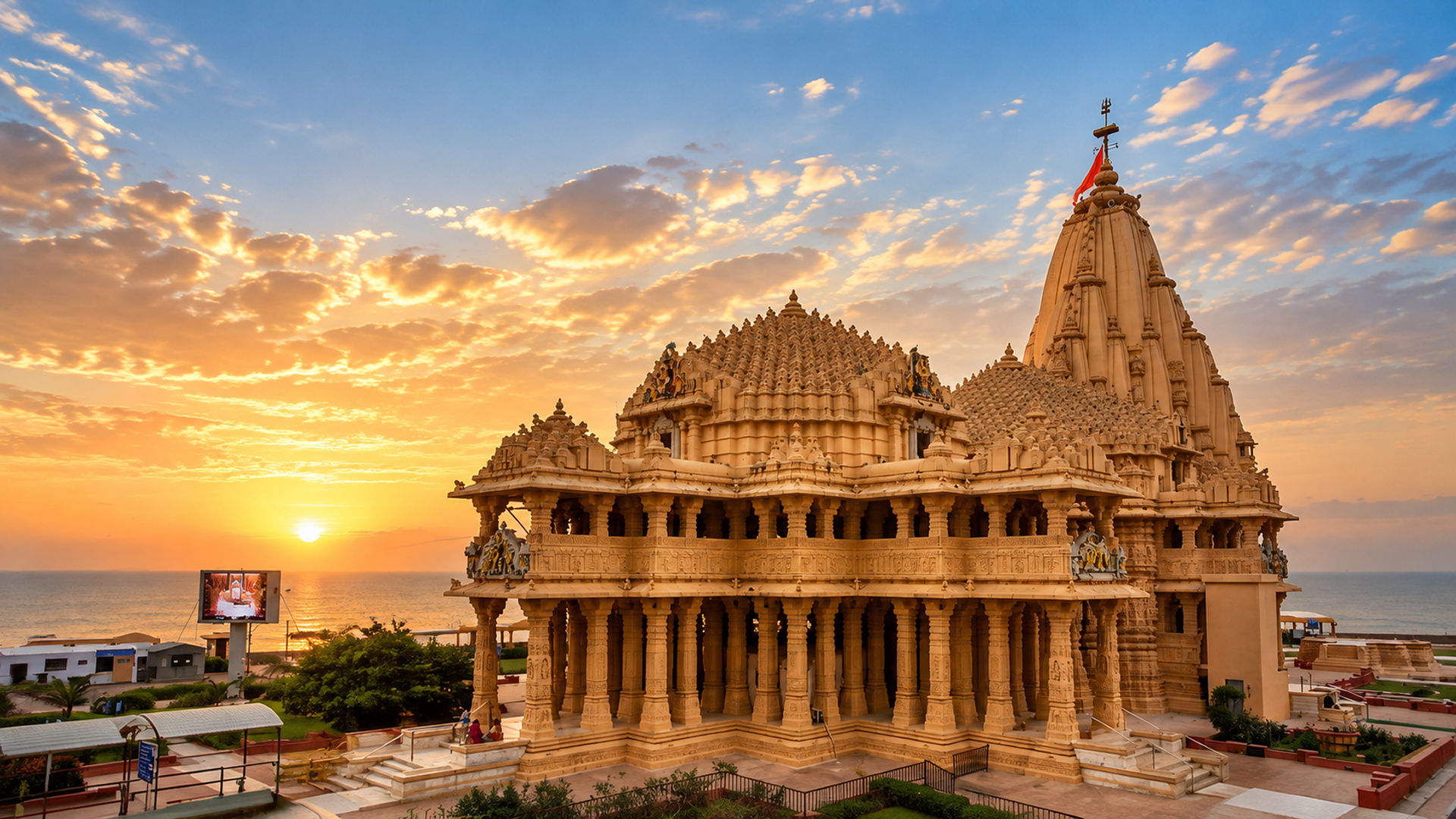
Somnath sits on the Arabian Sea coast in Saurashtra and holds one of Shiva’s twelve Jyotirlingas, the self-manifested forms of the deity venerated as the most powerful Shiva shrines in India. The Somnath temple visit is a highlight of any pilgrimage-focused itinerary through Gujarat, and the site has a history of destruction and rebuilding that few other Indian religious sites can match, with the current temple, completed in 1951 and largely funded by the Somnath Trust following India’s independence, being at least the seventh iteration built on the site.
Evening arti at Somnath is regularly named as the most atmospheric of any Jyotirlinga in India, held with the sea directly behind the temple and the sound of the waves audible through the ritual. The Somnath temple visit is booked into the itinerary as a single night, which is enough for the evening and morning ceremonies without stretching the schedule for the coastal drive that follows.
Lothal, the Harappan Port City and Its Ancient Dockyard
Between Bhavnagar and Vadodara on Day 10 of the itinerary, the route stops at Lothal, one of the southernmost and most significant sites of the Indus Valley civilization. Excavated in the 1950s under S. R. Rao, Lothal dates to roughly 2400 BCE and includes what many archaeologists consider the world’s earliest known dockyard, a massive baked-brick basin that connected the town to the Gulf of Khambhat and, through it, to Mesopotamian trade networks. The site pushed the accepted timeline of maritime engineering back by roughly two thousand years and remains the clearest surviving evidence of the Harappan trade economy at work.

The small ASI museum on site holds beads, seals, weights, and terracotta figurines recovered from the excavations, and the visit adds a distinctly different register to a heritage tour that otherwise focuses on temple and stepwell architecture.
What a Gujarat Heritage Tour Gets Right
A well-built gujarat heritage tour makes room for depth over speed, since sites like Rani ki Vav and Modhera reward slow observation of the carving in a way that a fifteen-minute stop cannot. The Jewels of Gujarat itinerary gets this right by giving Ahmedabad two full nights, treating Rani ki Vav and Modhera as an excursion in their own right and not a photo stop, and building in enough time at Dwarka and Somnath for the evening rituals that give both sites their character.
A gujarat heritage tour that spends most of its time on the road and not at the sites themselves ends up missing the point, and one of the reasons this particular itinerary works is how driving days are weighed against ground time at each stop.
For travellers comparing options, the broader route is covered in our guide to Gujarat tour packages. Immersive Trips also designs customized India tours, so this Gujarat heritage tour can be extended or reshaped around the sites that matter most to you.
Best Time for a Gujarat Heritage Tour
November through February gives the most comfortable weather for a heritage-focused visit, with cooler days making the extended walking around Ahmedabad’s pols and the stepwell descent at Rani ki Vav less demanding. March and April bring heat that turns the open courtyards at Modhera and the exposed sculpture at Rani ki Vav into difficult midday visits, and the monsoon months from June to September add humidity that affects the outdoor components of the trip more than the temple interiors themselves.
Booking the Jewels of Gujarat Tour
Immersive Trips runs this itinerary as a fixed twelve-day route with private transport, hotel bookings across seven cities, and meal plans handled as one arrangement. Current departure dates, hotel category options, and pricing are listed on the Jewels of Gujarat tour page, where the trip can be booked directly, and the team can be reached for a tailored quote or any questions before booking.
Frequently Asked Questions
Which sites does this Gujarat heritage tour include?
Ahmedabad’s UNESCO-listed old city and heritage walk, Modhera Sun Temple, Rani ki Vav in Patan, Dwarkadhish Temple and Bet Dwarka, Somnath Temple, and the Lothal Harappan site are all built into the twelve-day route.
Is the Rani ki Vav stepwell open to visitors year-round?
Yes. The site is open to visitors throughout the year, with the cooler months from November to February being the most comfortable for the descent into the stepwell.
How long does the Modhera Sun Temple visit take?
Most itineraries allocate around two to three hours for Modhera, which allows time for both the temple and the surya kund tank in front of it.
Can non-Hindu visitors enter the Somnath and Dwarkadhish temples?
Non-Hindu visitors can generally visit both, though Somnath asks non-Hindus to register at the temple office first, and phones must be deposited before entering the complex. Rules change, so check at the gate.
Is Lothal worth the detour on the way to Vadodara?
For anyone interested in the Indus Valley civilization, yes. Lothal is one of the most complete Harappan sites in India and includes the world’s earliest known dockyard.
How much time does the itinerary give to the heritage sites overall?
Roughly half the twelve-day trip is built around heritage stops, with the other half covering the Little Rann of Kutch safari, the Banni villages, and the Statue of Unity at Kevadia.
How long should a Somnath temple visit take?
One night is enough to attend the evening arti and the morning ceremony, which is how this itinerary schedules the Somnath temple visit.