
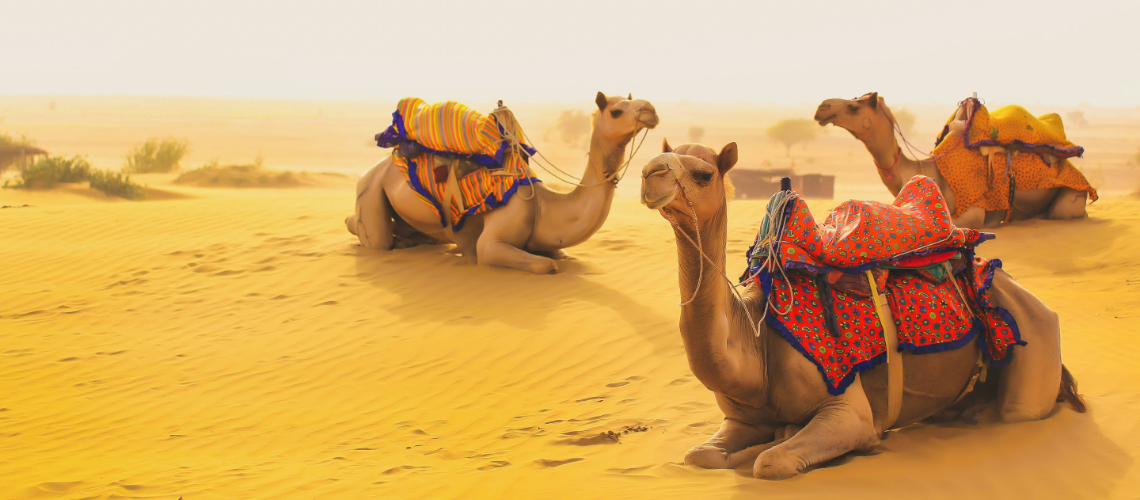
Jaisalmer, the Golden City, rises from the heart of the Thar Desert like a mirage, its honey-coloured sandstone glowing under the desert sun. At its centre stands one of the very few “living forts” in the world, where a quarter of the old city’s population still lives, works, and worships within the twelfth-century walls. Beyond the fort lie intricately carved merchant havelis, a serene desert lake, and, a short drive away, the golden dunes of the Sam Sand Dunes, where camel safaris, desert camps, and starlit folk music await. This Jaisalmer travel guide covers everything you need to plan a rewarding visit: the essential sights, the desert experiences, the food, and practical tips for the Golden City.
For full state planning, see our Rajasthan travel guide, and for curated itineraries, our Rajasthan tour packages collection.
Jaisalmer Travel Guide: Understanding the Golden City
Jaisalmer was founded in 1156 by the Bhati Rajput ruler Maharawal Jaisal Singh, who established his capital on Trikuta Hill in the heart of the Thar Desert, guided (according to legend) by a prophecy of Lord Krishna. For centuries, the city thrived as a crucial way-station for the camel caravans of the ancient trade routes connecting India with Central Asia and beyond, and the wealth of its merchants funded the extraordinary carved havelis that still stand today. The fort survived attacks by rulers including Alauddin Khilji and the Mughal emperor Humayun, and today it is a UNESCO World Heritage Site as one of the hill forts of Rajasthan.
What makes Jaisalmer unique is that its fort is a living fort: unlike most forts, which are monuments, Jaisalmer Fort still houses shops, hotels, temples, and homes where generations continue to live. Walking through it feels less like sightseeing and more like stepping into someone’s daily life. Two to three days is ideal for Jaisalmer and the desert.

Best Places to Visit in Jaisalmer
Jaisalmer Fort (Sonar Quila)
The Jaisalmer Fort, known as the Sonar Quila (Golden Fort), is the beating heart of the city and one of the largest forts in India. Built in 1156 on Trikuta Hill, this UNESCO-listed living fort glows golden at sunrise and sunset, and its ramparts offer spectacular views over the desert city. Within its walls lie the Raj Mahal (royal palace and museum), a group of exquisitely carved Jain temples, shops, cafes, and the homes of the families who still live inside. Wandering its lanes, with children racing past and temple bells echoing, is a unique experience. Our places to visit in Jaisalmer guide covers the fort in detail.
Patwon Ki Haveli
Patwon Ki Haveli, the most famous of Jaisalmer’s merchant mansions, is a cluster of five intricately carved havelis built by a wealthy trader for his sons in the 19th century. Renowned for its yellow sandstone facade, ornate balconies, latticework, mirror work, and wall paintings, it offers a fascinating glimpse into the luxurious lifestyle of Jaisalmer’s prosperous trading families. The top floor offers panoramic views of the fort that many visitors miss.
Salim Singh Ki Haveli and Nathmal Ki Haveli
Salim Singh Ki Haveli, famous for its distinctive peacock-shaped roof and beautifully carved balconies, and Nathmal Ki Haveli, known for its fascinating blend of symmetry and subtle asymmetry (built by two architect brothers working on separate halves), complete the trio of great Jaisalmer havelis. Together, the three havelis trace a timeline of desert merchant prosperity across two centuries.
Gadisar Lake
Gadisar Lake, built in the 14th century by Maharawal Gadsi Singh as the city’s primary water reservoir, is a serene desert oasis surrounded by temples, shrines, cenotaphs, and the beautifully carved Tilon Ki Pol gateway. Boating on the lake, particularly at sunrise, is a peaceful and photogenic experience, and in winter, the lake attracts migratory birds. An evening laser and light show adds another dimension.
Desert Experiences at Sam Sand Dunes
The quintessential Jaisalmer experience lies about 40 to 45 kilometres from the city at the Sam Sand Dunes, a stretch of rolling golden dunes that offers the classic Thar Desert adventure. Here you can take a camel safari across the sand, watch an unforgettable desert sunset as the dunes turn from gold to amber to pink, enjoy Rajasthani folk music and dance around a bonfire, and spend the night at a desert camp under a sky full of stars.
An overnight camp is consistently described by travellers as the single strongest Jaisalmer memory. Adventure options include jeep safaris (dune bashing), quad biking, and paramotoring. The quieter Khuri dunes offer a similar experience with fewer crowds. Our desert safari in Rajasthan guide covers the desert experience in detail.

Other Places to Visit near Jaisalmer
Kuldhara, the famous abandoned village about 20 kilometres from the city, was deserted overnight by its Paliwal Brahmin residents nearly 200 years ago and stands eerily frozen in time. Bada Bagh is a complex of royal cenotaphs set on a hill, beautiful at sunset. The Desert National Park protects the Thar’s unique ecosystem and wildlife, including the endangered Great Indian Bustard. Our offbeat places in Rajasthan guide covers Kuldhara.
Food and Dining Experiences in Jaisalmer
Jaisalmer’s food scene is enhanced by its extraordinary settings: dining inside the golden fort, on rooftops overlooking the desert city, or at a desert camp under the stars. Rooftop restaurants serve laal maas, traditional thalis, and international dishes with fort or desert views. Our places to eat in Jaisalmer guide covers the city’s food scene in full.
Jaisalmer Travel Guide: Essential Travel Tips
- Build in a desert night. An overnight stay at a desert camp near the Sam Sand Dunes is the highlight of a Jaisalmer visit and should be planned in rather than treated as optional.
- Explore the fort and havelis on foot. The fort and the three main havelis are within walking distance of each other and can be covered in a focused morning.
- Time the dunes for sunset. Arrive at the Sam Sand Dunes in the late afternoon for the camel safari and the spectacular sunset, followed by the folk performances and dinner.
- Visit in winter. October to March offers the most comfortable weather, with February adding the Jaisalmer Desert Festival for cultural depth. Jaisalmer’s desert location makes it extremely hot from April to June.
- Consider the conservation issue with fort stays. While staying inside the living fort is atmospheric, there are ongoing conservation concerns about accommodation within the fort. Many responsible travellers choose havelis or hotels just outside the walls instead.
Plan your Jaisalmer visit with Immersive Trips
At Immersive Trips, we craft Jaisalmer itineraries that capture the magic of the golden fort, the artistry of the havelis, and above all, the unforgettable desert experience of camel safaris and starlit camps. Get in touch with our team to plan your Golden City and desert adventure.
Frequently asked questions about visiting Jaisalmer
How many days do I need in Jaisalmer?
Two to three days is ideal. This allows a day for the fort and havelis, a day (and night) for the desert experience at the Sam Sand Dunes, and time for Gadisar Lake, Kuldhara, and Bada Bagh. Three days comfortably cover the full fort, dunes, and desert heritage circuit.
What is special about Jaisalmer Fort?
Jaisalmer Fort (Sonar Quila) is one of the very few u0022living fortsu0022 in the world, where roughly a quarter of the old city’s population still lives, works, and worships within the twelfth-century walls. Built in 1156 on Trikuta Hill and now a UNESCO World Heritage Site, it houses shops, hotels, temples, and homes, making a visit feel like stepping into daily life rather than a monument.
Is the desert safari at Sam Sand Dunes worth it?
Absolutely. The Sam Sand Dunes, about 40 to 45 kilometres from the city, offer the quintessential Thar Desert experience: camel safaris, spectacular sunsets, folk music and dance around a bonfire, and overnight desert camps under a sky full of stars. An overnight camp is consistently described by travellers as the single strongest Jaisalmer memory.
What are the best havelis to visit in Jaisalmer?
The three essential havelis are Patwon Ki Haveli (a cluster of five intricately carved mansions, the most famous), Salim Singh Ki Haveli (with its distinctive peacock-shaped roof), and Nathmal Ki Haveli (known for its symmetry and subtle differences). Together they trace a timeline of desert merchant prosperity across two centuries.
What is the best time to visit Jaisalmer?
October to March offers the most comfortable weather, ideal for exploring the fort and enjoying the desert. February adds the Jaisalmer Desert Festival, a colourful celebration of desert culture. The summer months (April to June) are extremely hot given the desert location and are best avoided.
Should I stay inside the Jaisalmer Fort?
Staying inside the living fort is atmospheric and unique, but there are ongoing conservation concerns about the strain that accommodation and tourism place on the twelfth-century structure and its drainage. Many responsible travellers choose to stay in havelis or hotels just outside the fort walls, which still offer wonderful views and atmosphere. A good operator can advise on the most responsible choice.
What is Kuldhara, and is it worth visiting?
Kuldhara, about 20 kilometres from Jaisalmer, is a famous abandoned village deserted overnight by its Paliwal Brahmin residents nearly 200 years ago, and now standing eerily frozen in time. Its ruined sandstone homes, ghostly legends, and desert setting make it one of the most intriguing and atmospheric places to visit near Jaisalmer, easily combined with a desert safari.
What is Gadisar Lake?
Gadisar Lake, built in the 14th century as Jaisalmer’s primary water reservoir, is a serene desert oasis surrounded by temples, shrines, cenotaphs, and the beautifully carved Tilon Ki Pol gateway. Boating on the lake, particularly at sunrise, is a peaceful and photogenic experience, and an evening laser and light show adds another dimension.
What desert activities are available in Jaisalmer?
Beyond camel safaris and overnight camping, the Sam Sand Dunes offer jeep safaris (dune bashing), quad biking, and paramotoring for adventurous travellers, along with folk music and dance performances and spectacular sunsets. The quieter Khuri dunes offer a similar experience with fewer crowds. Our u003ca href=u0022http://immersive-trips/blog/desert-safari-in-rajasthan/u0022u003edesert safari in Rajasthanu003c/au003e guide covers the options.
How do I get to Jaisalmer?
Jaisalmer has an airport with seasonal flights (primarily in the winter tourist months) from Delhi, Jaipur, and other cities, and is well connected by train and road. It is approximately 4.5 to 5 hours from Jodhpur by road, the most common approach. Our u003ca href=u0022http://immersive-trips/blog/how-to-reach-rajasthan/u0022u003ehow to reach Rajasthanu003c/au003e guide covers the options.