
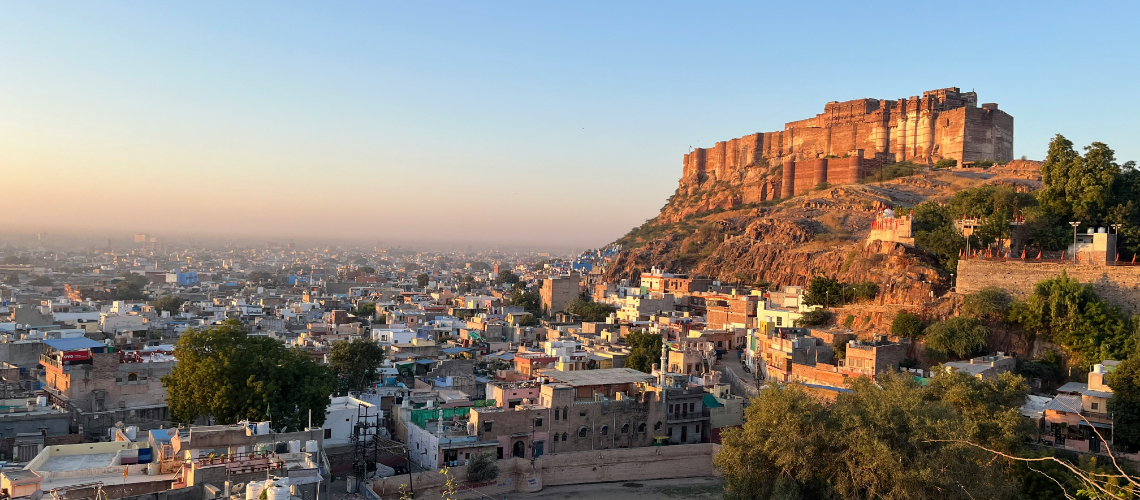
The places to visit in Jodhpur range from one of the largest and most magnificent forts in India to a glowing marble memorial, from one of the world’s largest private palaces to a maze of indigo-painted lanes, ancient stepwells, and royal cenotaphs. The Blue City, built by the Rathore dynasty in 1459 and still watched over by their fortress, packs an extraordinary concentration of atmosphere and heritage into a compact old city on the edge of the Thar Desert. This guide covers every significant place worth visiting, with the historical context and practical details you need to plan your time in Jodhpur.
For activity ideas and trip planning, see our things to do in Jodhpur and Jodhpur travel guide.
Mehrangarh Fort
The Mehrangarh Fort is the crowning glory of Jodhpur and one of the finest and largest forts in India. Built from 1459 by Rao Jodha on a rocky hill rising some 120 to 125 metres above the city, and expanded over the following centuries (much of the existing structure dating to the reign of Maharaja Jaswant Singh in the 17th century), it remains owned by the Rathore dynasty that built it.
The fort houses an outstanding museum of palanquins, royal cradles, miniature paintings, costumes, and an armoury of weapons, alongside beautifully decorated palaces including the Moti Mahal (Pearl Palace), the Phool Mahal (Flower Palace), and the Sheesh Mahal (Mirror Palace), with their exquisite latticed windows and carved panels. The fort has seven gates, including the Jai Pol (built to mark a military victory) and the Fateh Pol, and its second gate still bears the marks of cannonball attacks. The ramparts offer spectacular views over the blue city below. Arrive around 9 am and allow two and a half to three hours.
Jaswant Thada
The Jaswant Thada, a short walk below the fort, is a striking white marble memorial (cenotaph) built in 1899 by Maharaja Sardar Singh in honour of his father, Maharaja Jaswant Singh II, and often called the Taj Mahal of Marwar. Built from thin sheets of polished marble that glow with a warm, translucent light when the sun strikes them and set beside a garden and a small lake, it contains portraits of the Marwar rulers and remains the cremation ground of the royal family. It is one of the most peaceful and beautiful spots in Jodhpur.

Umaid Bhawan Palace
The Umaid Bhawan Palace, perched on Chittar Hill, is one of the largest private residences in the world. Built between 1928 and 1943 by Maharaja Umaid Singh as a famine-relief project to provide employment during a period of drought, this vast palace of sandstone and marble (also known as the Chittar Palace) blends Indo-Saracenic, Classical Revival, and Art Deco styles, and was designed by the British architect H.V. Lanchester. It is divided into three parts: the private residence of the royal family, a luxury Taj hotel, and a museum open to the public, displaying royal artefacts, artworks, clocks, and a fascinating collection of vintage cars.
The Blue City and Toorji Ka Jhalra
The blue-painted old city below the fort is one of the most photographed sights in Rajasthan, a maze of indigo lanes best explored on foot. At its heart, the beautifully restored Toorji Ka Jhalra stepwell, with its intricate carving, anchors a revitalised district of cafes, boutiques, and rooftop restaurants, and is particularly atmospheric in the evening when illuminated. The Ghanta Ghar (Clock Tower) and surrounding Sardar Market form the bustling commercial heart of the old city.
Mandore Gardens
The Mandore Gardens, about 8 kilometres from the city, mark the site of the old Marwar capital before Jodhpur was founded. The gardens contain the striking red sandstone cenotaphs of the Marwar rulers, built in the style of Hindu temples with fine columns and spires (the most prominent being that of Maharaja Ajit Singh, built in 1793), along with a hall of heroes displaying brightly coloured statues of folk deities. Set among greenery and langur monkeys, it offers a quieter, atmospheric contrast to the main city sights.
Rao Jodha Desert Rock Park
The Rao Jodha Desert Rock Park, created in 2006 beside the fort, restores the natural ecology of the rocky wasteland around Mehrangarh. Its walking trails through volcanic rock offer beautiful views of the fort and city, and a chance to see the local flora and fauna of the Thar Desert. It is one of the most underrated and peaceful places to visit in Jodhpur, particularly on the morning guided walks.
Jaswant Thada viewpoints and Pachetia Hill
For the best views over the blue city and the fort, Pachetia Hill (reached from the Chandpol gate) offers a free, unobstructed vantage point, particularly beautiful at sunrise. The Maa Jwalamukhi Devi Temple on the hill adds a spiritual dimension to the climb.

Kaylana Lake and beyond
Kaylana Lake, an artificial lake about 8 kilometres west of the city, offers a peaceful setting for a sunset, popular with local visitors. For those with more time, the surrounding region offers Bishnoi villages (for a cultural safari), Osian (for desert temples and dunes), and other excursions into the Marwar countryside. Our offbeat places in Rajasthan guide covers these.
Plan your Jodhpur visit with Immersive Trips
At Immersive Trips, we help travellers experience the best of Jodhpur’s extraordinary sights, from the mighty fort to the blue lanes to the royal palaces and gardens, with the local knowledge to get the timing and logistics right. Get in touch with our team to plan your Blue City visit.
Frequently asked questions about places to visit in Jodhpurpur
What is the most important place to visit in Jodhpur?
Mehrangarh Fort is the most important and impressive place to visit in Jodhpur, one of the largest and finest forts in India, rising some 120 to 125 metres above the city. Its museum, decorated palaces, and ramparts with spectacular views over the blue city make it the essential Jodhpur sight.
How many places can I visit in Jodhpur in one day?
In one day, you can comfortably visit Mehrangarh Fort (morning), Jaswant Thada nearby, and spend the afternoon exploring the blue city lanes, the Toorji Ka Jhalra stepwell, and Sardar Market. A second day allows the Umaid Bhawan Palace, Mandore Gardens, and the Rao Jodha Desert Rock Park.
Is Mehrangarh Fort worth visiting?
Absolutely. Mehrangarh Fort is one of the finest forts in India, with an outstanding museum, beautifully decorated palaces (Moti Mahal, Phool Mahal, Sheesh Mahal), seven historic gates, and ramparts offering spectacular views over the blue city. It is the essential Jodhpur experience and one of the highlights of Rajasthan.
What is Jaswant Thada?
Jaswant Thada is a striking white marble memorial (cenotaph) built in 1899 in honour of Maharaja Jaswant Singh II, often called the Taj Mahal of Marwar. Built from thin polished marble that glows in the sun and set beside a garden and lake, it is one of the most peaceful and beautiful spots in Jodhpur, a short walk below the fort.
What is special about the Umaid Bhawan Palace?
The Umaid Bhawan Palace is one of the largest private residences in the world, built between 1928 and 1943 as a famine-relief project. It blends Indo-Saracenic, Classical Revival, and Art Deco styles and is divided into the royal family’s residence, a luxury Taj hotel, and a museum displaying royal artefacts, artworks, and a collection of vintage cars.
Why are the houses in Jodhpur blue?
The houses in Jodhpur’s old city are painted indigo blue, which originally denoted Brahmin homes. The copper-sulphate limewash used to create the colour also doubles as a termite repellent and helps keep houses cool. Today, anyone can paint their house blue, but a civic code maintains the same indigo shade, giving the Blue City its distinctive character.
Is the Toorji Ka Jhalra stepwell worth visiting?
Yes. The beautifully restored Toorji Ka Jhalra stepwell, with its intricate carving, is the heart of a revitalised old-city district surrounded by cafes, boutiques, and rooftop restaurants. It is particularly atmospheric in the evening when illuminated, and makes a lovely stop while exploring the blue city.
What is Mandore Gardens known for?
Mandore Gardens, about 8 kilometres from Jodhpur, marks the site of the old Marwar capital and is known for its striking red sandstone cenotaphs of the Marwar rulers, built in the style of Hindu temples, along with a hall of heroes. Set among greenery and langur monkeys, it offers a quieter, atmospheric contrast to the main city sights.
Are there any peaceful or lesser-known places in Jodhpur?
Yes. The Rao Jodha Desert Rock Park (with its trails and fort views), the Mandore Gardens, Kaylana Lake (for sunsets), and Pachetia Hill (for sunrise views) are all quieter, atmospheric places that offer a more peaceful contrast to the busy fort and markets, and reward travellers who want to go beyond the main sights.
What is the best time to visit Jodhpur’s sights?
October to March offers the most comfortable weather. Mehrangarh Fort is best visited soon after the 9 am opening for the best light and fewest crowds, and Pachetia Hill is best at sunrise. The summer months (April to June) are extremely hot, with the fort’s stone radiating significant heat by midday.