
Few states in India offer as many extraordinary best places to visit in Rajasthan, the Land of Kings. From UNESCO World Heritage hill forts to lake palaces, from the golden dunes of the Thar Desert to sacred temple towns, Rajasthan packs more iconic destinations into a single state than most countries manage in their entirety. This guide covers every major place worth visiting, organised by city and region, with the context you need to decide what to include in your itinerary and how much time each deserves.
For curated routes covering these destinations, see our collection of Rajasthan tour packages.
Jaipur: the Pink City
Jaipur, the capital of Rajasthan, is the gateway to the state and the first stop on almost every itinerary. Founded in 1727 by Maharaja Jai Singh II, it is the first planned city in India, laid out on a grid according to the principles of Vastu Shastra. The old city was painted pink (traditionally the colour of hospitality) in 1876 to welcome the Prince of Wales, and the name has stuck.
Essential places to visit in Jaipur include the Amber Fort, a magnificent hilltop fortress overlooking Maota Lake with its famous Sheesh Mahal (mirror palace); the City Palace, a blend of Mughal and Rajput architecture still partly inhabited by the royal family; the Hawa Mahal (Palace of Winds), with its iconic honeycomb facade; and Jantar Mantar, a UNESCO-listed astronomical observatory of monumental stone instruments. Nahargarh and Jaigarh forts crown the hills above the city. Our Jaipur travel guide covers the city in full detail.
Udaipur: the City of Lakes
Udaipur, often called the Venice of the East and the most romantic city in India, is built around a series of artificial lakes against the backdrop of the Aravalli hills. Founded in 1559 by Maharana Udai Singh II, it is the historic capital of the Mewar kingdom.
The essential place to visit is the City Palace of Udaipur, one of the largest palace complexes in India, built on the banks of Lake Pichola with panoramic views across the water. The Lake Palace (now a luxury hotel) appears to float on the lake itself, while the Jag Mandir island palace offers another romantic vantage. Other highlights include the Jagdish Temple, the Saheliyon Ki Bari (Garden of the Maids of Honour), and Fateh Sagar Lake. A sunset boat ride on Lake Pichola is one of the defining experiences in Indian travel. Our Udaipur travel guide covers the city fully.
Jodhpur: the Blue City
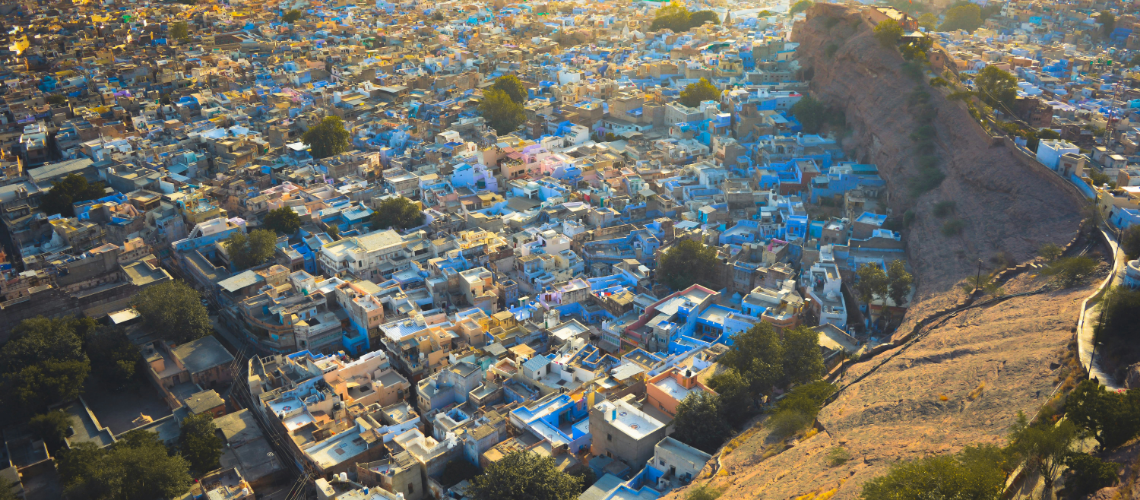
Jodhpur, the second-largest city in Rajasthan, is famous for the sea of blue-painted houses that spill out below its towering fortress. The blue, originally associated with Brahmin residents and later adopted more widely (partly because the indigo copper-sulphate wash deterred termites and kept houses cool), gives the old city its distinctive character.
The dominant place to visit is Mehrangarh Fort, one of the largest and most magnificent forts in India, rising 120 metres above the city on a rocky hill and housing an outstanding museum of palanquins, paintings, and royal artefacts. Below it sits Jaswant Thada, a serene white marble memorial, and the Toorji Ka Jhalra stepwell, beautifully restored. The Umaid Bhawan Palace, one of the world’s largest private residences, is part royal home, part luxury hotel, and part museum. Our Jodhpur travel guide covers the city in detail.

Jaisalmer: the Golden City
Jaisalmer rises from the Thar Desert like a golden mirage, its sandstone architecture glowing under the desert sun. Founded in 1156 by the Bhati Rajput ruler Maharawal Jaisal Singh, it served as a vital way-station for camel caravans along the ancient trade routes.
The centrepiece is Jaisalmer Fort (Sonar Quila), one of the very few “living forts” in the world, where roughly a quarter of the old city’s population still resides within the walls. A UNESCO World Heritage Site, it contains temples, havelis, shops, and homes within its ramparts. The intricately carved Patwon Ki Haveli and Salim Singh Ki Haveli showcase the artistic brilliance of the desert merchants. Just outside the city, the Sam Sand Dunes offer the classic Thar Desert experience of camel safaris, dune camping, and folk performances under the stars. Our Jaisalmer travel guide covers it all.
Pushkar: the sacred lake town
Pushkar is one of the oldest and most sacred towns in India, built around a holy lake ringed by 52 ghats and hundreds of temples. It is home to one of the very few temples in the world dedicated to Lord Brahma, the creator god. The town is also famous for the annual Pushkar Camel Fair, one of the largest livestock fairs in the world, which draws hundreds of thousands of visitors each November. Pushkar’s relaxed, spiritual atmosphere and its proximity to Jaipur make it a natural addition to most itineraries. Our Pushkar travel guide covers the town in detail.
Ranthambore National Park
Ranthambore, near Sawai Madhopur between Jaipur and the southern cities, is one of India’s most famous tiger reserves and offers among the best chances in the country of seeing a wild Bengal tiger. The park combines dense forest and open grassland with the atmospheric ruins of Ranthambore Fort within its boundaries. Jeep and canter safaris run in the mornings and afternoons. Our wildlife tours in Rajasthan guide covers the reserve and its safaris in detail.

Kumbhalgarh and Ranakpur
Kumbhalgarh Fort, in the Aravalli hills near Udaipur, is encircled by a wall that stretches approximately 36 kilometres, the second-longest continuous wall in the world after the Great Wall of China. The birthplace of the legendary Mewar king Maharana Pratap, it is a UNESCO World Heritage Site and one of the most impressive forts in India. Nearby, the Ranakpur Jain Temple, a 15th-century marble masterpiece with 1,444 uniquely carved pillars, is one of the finest examples of temple architecture in the country and a natural stop between Udaipur and Jodhpur.
Bikaner
Bikaner, in the northern desert, is a less-visited but rewarding destination known for the magnificent Junagarh Fort (one of the few major forts in Rajasthan not built on a hilltop), the ornate havelis of its old city, and its camel breeding farm. The unusual Karni Mata Temple at nearby Deshnoke, home to thousands of revered rats, is one of the most unusual religious sites in India.
Mount Abu
Mount Abu, Rajasthan’s only hill station, sits in the Aravalli Range and offers a cool retreat even in summer. Its highlight is the Dilwara Temples, a group of Jain temples renowned for their extraordinarily intricate marble carvings, widely considered among the finest in India. Nakki Lake and the sunset points add to the hill station’s appeal.
Chittorgarh and Bundi
Chittorgarh Fort, one of the largest forts in India and a UNESCO World Heritage Site, is steeped in Rajput history and legends of valour and sacrifice. Bundi, a lesser-visited town near Kota, is known for its intricate stepwells (baoris), its atmospheric palace covered in Rajput murals, and its relaxed, un-touristed charm, making it a favourite for travellers seeking Rajasthan beyond the main circuit. Our offbeat places in Rajasthan guide covers these hidden gems.
Plan your Rajasthan visit with us
At Immersive Trips, we help travellers choose the right combination of places for their interests, time, and travel style, weaving the iconic sights together with the quieter gems that most itineraries miss. Get in touch with our team to build your ideal Rajasthan journey.
Frequently asked questions about places to visit in Rajasthan
What are the must-visit places in Rajasthan?
The five essential destinations are Jaipur (the Pink City), Udaipur (the City of Lakes), Jodhpur (the Blue City), Jaisalmer (the Golden City), and Pushkar (the sacred lake town). Beyond these, Ranthambore for tigers, Kumbhalgarh for its fortress walls, and Mount Abu for its Jain temples are the most rewarding additions.
How many places can I cover in a week in Rajasthan?
In seven days, you can comfortably cover three to four cities, typically Jaipur, Pushkar, Udaipur, and Jaisalmer, or a more compact loop of Jaipur, Jodhpur, and Udaipur. Attempting more than four destinations in a week results in a rushed experience given the distances involved.
Which is the most beautiful city in Rajasthan?
Udaipur is most frequently cited as the most beautiful, with its lakes, palaces, and hillside setting earning it the title of the Venice of the East and India’s most romantic city. Jaisalmer’s golden desert setting and Jodhpur’s blue city and fortress are equally striking in their own distinct ways.
Is Ranthambore worth visiting for a tiger safari?
Yes, if wildlife is a priority. Ranthambore offers among the best chances in India of seeing a wild Bengal tiger, alongside the atmospheric Ranthambore Fort within the park. Two nights allow two safari attempts, which significantly improve the odds of a sighting.
What is special about Kumbhalgarh Fort?
Kumbhalgarh is encircled by a wall stretching approximately 36 kilometres, the second-longest continuous wall in the world after the Great Wall of China. A UNESCO World Heritage Site and the birthplace of Maharana Pratap, it is one of the most impressive and atmospheric forts in Rajasthan and pairs well with the nearby Ranakpur Jain Temple.
Which places in Rajasthan are best for families?
Jaipur (with its elephant and jeep experiences at Amber Fort), Jaisalmer (with camel safaris and desert camping), and Ranthambore (for wildlife safaris) are particularly engaging for families. Udaipur’s boat rides and Jodhpur’s fort are also enjoyable for all ages. Our family tour packages in Rajasthan guide covers this fully.
Are there offbeat places worth visiting in Rajasthan?
Yes. Bundi (for its stepwells and murals), Chittorgarh (for its historic fort), Bikaner (for its havelis and camel farm), and the Shekhawati region (for its painted havelis) offer rewarding experiences away from the main tourist circuit. Our offbeat places in Rajasthan guide covers these in detail.
How much time should I spend in each Rajasthan city?
As a rough guide: Jaipur deserves two to three days, Udaipur two days, Jodhpur one to two days, Jaisalmer two days (including a desert night), and Pushkar one day. Ranthambore requires two nights for two safaris. Adjusting these to your specific interests yields the best experience.
Which Rajasthan destinations are UNESCO World Heritage Sites?
Six hill forts of Rajasthan are jointly inscribed on the UNESCO World Heritage List: Amber Fort (Jaipur), Chittorgarh Fort, Kumbhalgarh Fort, Ranthambore Fort, Gagron Fort, and Jaisalmer Fort. Jaipur’s Jantar Mantar and the walled city of Jaipur itself are also UNESCO-listed.
Can I visit Rajasthan’s desert and lakes in one trip?
Yes. A well-planned circuit combines the desert experience of Jaisalmer with the lakes of Udaipur and the forts of Jaipur and Jodhpur, giving you the full range of Rajasthan’s contrasting landscapes in a single trip. Ten to fourteen days allows all of this at a comfortable pace.