
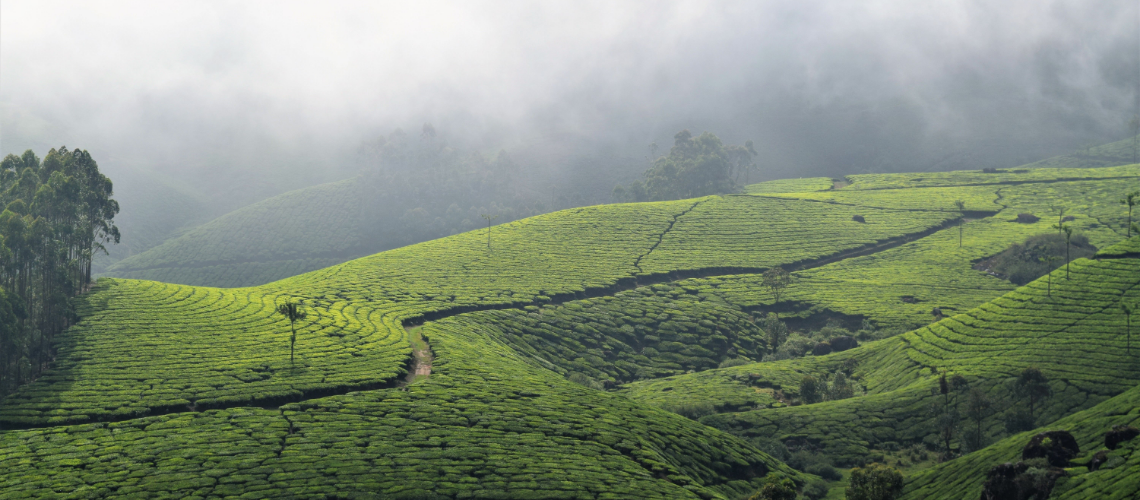
Kerala’s tea plantations are among the most visually striking agricultural landscapes anywhere in the world: vast rolling hills covered entirely in low, dark green tea bushes, threaded with narrow paths and punctuated by forest-covered peaks and morning mist. Tea plantation tours in Kerala range from a short guided walk through a working estate to a full-day jeep journey to the world’s highest tea plantation, and the experience offers far more than scenery. It is a window into the colonial-era history that shaped the Western Ghats, the science and craft of tea processing, and the daily life of the communities who continue to work these hills today.
For broader trip planning, our Munnar travel guide covers the heart of Kerala’s tea country in full detail. For a wider overview of the state, explore our Kerala Travel Guide and our guide to the Best Things to Do in Kerala to help plan a complete Kerala itinerary.
History of Tea Cultivation in Kerala
Tea cultivation in the Munnar hills began in the late 19th century, when British planters, initially under the Finlay Muir company, recognised the suitability of the high-altitude Western Ghats climate for tea production. The estates that emerged over subsequent decades transformed the landscape almost entirely: hillsides that had been forest became continuous plantations of low, manicured tea bushes, a transformation that remains the dominant visual feature of the Munnar region today.
Many of the original estates were eventually consolidated under Tata Tea (now part of Tata Consumer Products), which continues to manage a significant portion of the plantation land around Munnar. Today, several companies and smaller independent estates also operate across the region, each contributing to the landscape that draws visitors specifically for plantation tours.

Best Places for Tea Plantation Tours in Kerala
Munnar
Munnar, at approximately 1,600 metres above sea level in the Idukki district, is the centre of Kerala’s tea industry and the most popular destination for plantation tours. The hillsides surrounding the town are almost entirely covered in tea bushes, creating one of the most photographed landscapes in South India. Most plantation tours here combine a guided walk through the rows of tea bushes with a visit to a working processing factory, where the stages of withering, rolling, fermentation, and drying are explained in detail.
The Tea Museum near Munnar town documents the history of the industry from its 19th-century origins, housing original plantation machinery and historical photographs. A guided factory tour at a working estate, arranged through most accommodation providers in the area, typically lasts two to three hours and concludes with a tea tasting session.
Kolukkumalai
Kolukkumalai, approximately 38 kilometres from Munnar and accessible only by jeep over a steep, narrow track, is home to what is considered the world’s highest tea plantation at around 7,900 feet above sea level. The factory here, built in the 1930s, remains one of the few in the world that still processes tea entirely using traditional orthodox methods rather than the more common modern CTC (crush-tear-curl) technique. This produces a tea with a distinctly different character: lighter, more nuanced, and reflective of the extreme altitude at which the leaves are grown.
The pre-dawn jeep journey to Kolukkumalai for the sunrise above the cloud line, followed by a tour of the factory and a tasting of the estate’s own tea, is widely regarded as one of the most extraordinary experiences available in Kerala.
Vagamon
Vagamon, between Kochi and Thekkady at around 1,100 metres in the Idukki district, offers a quieter, less-visited tea-plantation landscape, interspersed with pine forests and open meadows. The estates here are less commercially developed for tourism than those around Munnar, offering a more peaceful and less crowded plantation walking experience for travellers who have already explored the main Munnar circuit.
Wayanad
While better known for coffee, Wayanad also has tea estates in the higher-altitude sections of the district, particularly around Vythiri. The Wayanad estates are generally smaller and less commercially focused on tourism than those in Munnar, offering a quieter and more intimate plantation experience for visitors exploring the wider northern Kerala region.
What to Expect on a Tea Plantation Tour in Kerala
Walking through the tea rows: A guide leads visitors through the plantation, explaining the cultivation cycle, the plucking technique (typically two leaves and a bud, harvested by hand or, increasingly, by mechanical shears), and the ecology of the estate.
Factory tour: Visitors observe the journey from freshly plucked leaf to finished tea: withering (removing moisture from the leaf), rolling (breaking the cell structure to release enzymes), fermentation (developing flavour and colour), and drying or firing (stopping the fermentation process and preparing the leaf for packaging).
Tea tasting: Most tours conclude with a tasting session, often comparing different grades and styles produced by the estate, such as Broken Orange Pekoe, Flowery Orange Pekoe, or speciality orthodox teas.
Estate shopping: Estates typically sell freshly packaged tea directly to visitors, often at better prices and freshness than what is available in town shops.

Tips for Tea plantation Tours in Kerala
Book through your accommodation. Most resorts and homestays in Munnar, Vagamon, and Wayanad can arrange a guided plantation and factory tour with advance notice. This typically gives access to working estates rather than purely tourist-facing demonstrations.
Wear comfortable walking shoes. The terrain on tea estates can be uneven, and a good plantation walk often covers a fair distance across sloped ground.
Visit early in the morning. The light is best for photography in the early morning, and the air is cooler and more pleasant for walking before midday.
Make time for Kolukkumalai if you have the opportunity. The combination of the world’s highest tea estate, the sunrise above the clouds, and the traditional orthodox processing factory makes this the single most memorable tea-related experience in Kerala, even though it requires the most effort to reach.
Buy tea directly from the estate. Estate-direct tea, particularly orthodox-processed varieties from high-altitude gardens like Kolukkumalai, is generally fresher and better value than tea bought from general retail shops.
Plan your Tea Plantation Tour with Immersive Trips
At Immersive Trips, we know which estates offer the most genuine working plantation experience, how to arrange the Kolukkumalai sunrise jeep trip, and how to build a tea-focused day into a wider Munnar or Wayanad itinerary. Get in touch with our team or explore our Kerala tour packages.
Frequently asked questions about tea plantation tours in Kerala
1. Which is the best tea plantation to visit in Kerala?
For most travellers, Munnar offers the most accessible and well-organised plantation tours, with established estates and factories open for guided visits. For a more extraordinary experience, Kolukkumalai, the world’s highest tea plantation, offers a unique combination of altitude, traditional processing methods, and an unforgettable sunrise.
2. How long does a tea plantation tour take?
A standard guided walk and factory tour in Munnar typically takes two to three hours. A trip to Kolukkumalai, including the jeep journey, factory visit, and tasting, takes the better part of a morning, with departures before dawn and returns by mid-morning.
3. What is the difference between orthodox and CTC tea processing?
Orthodox processing preserves the leaf in larger, more intact pieces through traditional withering, rolling, and drying methods, producing tea with a more complex and nuanced flavour. CTC (crush-tear-curl) processing mechanically breaks the leaf into smaller, more uniform particles, producing a stronger, faster-brewing tea, more commonly used in mass-market tea bags. Kolukkumalai is notable for its continued use of the orthodox method.
4. Is the Kolukkumalai trip suitable for everyone?
The jeep journey to Kolukkumalai is rugged and can be uncomfortable for those with back problems or motion sensitivity. The altitude and early morning cold also require appropriate preparation, including warm clothing. It is generally suitable for most reasonably fit travellers but requires a tolerance for an early start and a bumpy ride.
5. Can I buy tea directly from the estates?
Yes. Most plantation tours conclude with the opportunity to purchase tea directly from the estate, often at better quality and pricing than retail shops in town. This is particularly worthwhile at Kolukkumalai, where the estate’s own orthodox-processed teas are distinctive and not widely available elsewhere.
6. What is the best time of year to visit Kerala’s tea estates?
October to March offers the most comfortable weather for plantation walks, with clear skies and cool temperatures. The monsoon months (June to September) make some access roads difficult to navigate but produce a particularly vivid green across the estates.
7. Are there tea plantation tours outside Munnar?
Yes. Vagamon offers a quieter tea estate landscape between Kochi and Thekkady, and parts of Wayanad, particularly around Vythiri, also have tea cultivation alongside the district’s more famous coffee estates. Both offer a less commercially developed alternative to the main Munnar circuit.
8. Do I need to book a tea plantation tour in advance?
For standard Munnar estate tours, advance booking through your accommodation is recommended but not always essential, particularly outside peak season. For the Kolukkumalai jeep trip, booking the previous evening through a local operator in Munnar town is standard practice and ensures availability for the early morning departure.
9. Is there an entry fee for tea plantation tours?
The Tea Museum near Munnar charges a nominal entry fee. Working estate tours arranged through accommodation providers are usually priced as a package including the guide, factory visit, and tasting. The Kolukkumalai trip typically involves a jeep hire cost plus a small entry or tasting fee at the estate.
10. What should I look for when choosing a tea to buy at the estate?
Ask about the grade (Broken Orange Pekoe, Flowery Orange Pekoe, and similar classifications indicate leaf size and quality) and whether the tea is orthodox or CTC processed. Orthodox teas, particularly from high-altitude estates like Kolukkumalai, tend to have more complex flavour profiles and are well worth the slightly higher price for those interested in quality tea.